About Malvax alliance
Accelerating the future of malaria vaccines R&D through global collaboration
The MalVax Alliance unites academia, industry, funders, policymakers, and implementers to share knowledge, coordinate efforts, and accelerate development of next-generation malaria vaccines through collaboration across the global R&D community.
Our Story
Our journey so far
The MalVax Alliance was established in response to a clear need identified by the global malaria vaccine R&D community for stronger coordination and collaboration.
The conversation begins
During consultative meetings held alongside the American Society of Tropical Medicine and Hygiene (ASTMH) Annual Meeting in 2024, leading researchers, funders, product developers, regulators, policymakers, and implementation partners came together to discuss the future of next-generation malaria vaccines R&D.
These discussions highlighted several persistent scientific and operational challenges to be addressed including increasing coordination, harmonising clinical trial designs, supporting and improving data comparability, and supporting increased clarity and evidence for funding, policy, regulatory and implementation pathways. Stakeholders agreed that an impartial and objective mechanism could help improve community coordination and alignment, accelerate and facilitate decision-making during product development, and help guide and accelerate the next phase of next-generation malaria vaccine innovation.
Challenges & barriers for next-generation malaria vaccines:
- The complexity of malaria transmission dynamics may require more than one type of vaccination
- Progress will be accelerated by harmonising clinical trial design and endpoint selection
- Understanding of trade-offs in vaccine characteristics, dosage, and cost, is needed in the early stages of clinical development
- Collaborative working & capacity strengthening will lead to better outcomes (including regulatory)
- Political will & positive public perception require advocacy for malaria vaccines
Building community consensus
A second consultative meeting at ASTMH in 2025 reinforced this vision. Participants reached broad consensus that the malaria vaccine field would benefit from a neutral, multi-stakeholder alliance. The recommendations from these consultations have shaped MalVax’s priorities and technical activities.
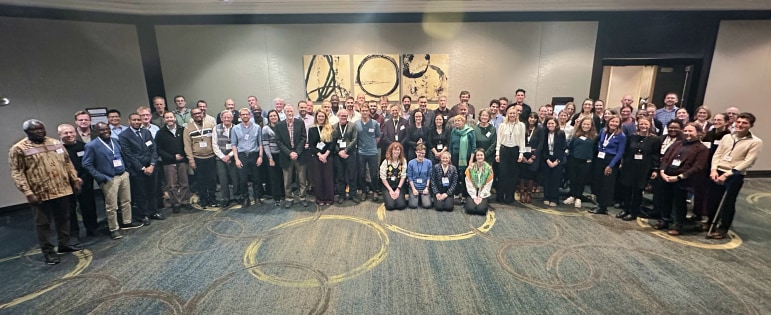
Identified needs from ASTMH consultations:
- Clinical trial designs will need to change as approved vaccines are rolled out
- There is uncertainty about how to adapt clinical trial endpoints to improve understanding of the full impact of next-gen vaccines
- Assay and endpoint harmonisation or standardisation will be needed to accelerate development of next-gen vaccines
- Community-led coordination across the malaria vaccine research community is needed to align shared analysis, infrastructure, and engagement with regulators and policymakers.
Establishing the MalVax Alliance
With financial support from Coefficient Giving, work began to establish the MalVax Alliance. To support this process, Bridges to Development was engaged as MalVax's interim Support Unit, bringing extensive experience in developing strategic global health partnerships.
These activities represent the foundation of a long-term collaborative platform for the global malaria vaccine R&D community.
2026 Activities
- Establishment of the Executive Committee
- Formation of the Advisory Group
- Launch of the inaugural technical Working Groups
- Development of the MalVax brand identity and communications platforms
- Creation of the MalVax website
- Planning for the inaugural MalVax Scientific Conference
Official launch
The MalVax Alliance will officially launch during its inaugural scientific conference, MalVax 2027: The First Global Malaria Vaccine Alliance R&D Conference, taking place in Kuala Lumpur, Malaysia from 31 January to 3 February 2027. It is expected that the MalVax Alliance will also transition from its interim governance arrangements to a permanent governance structure during 2027.


Our Vision
Accelerating the development of better vaccines for a malaria free future.
Vision & Mission
Our Mission
The MalVax Alliance unites the malaria vaccine R&D community to drive evidence and innovation from lab to policy faster, so better vaccines reach the people who need them sooner. It coordinates action around shared priorities by:
Strengthening innovation and clinical investigation through shared frameworks
Improving the quality and comparability of research evidence
Accelerating the translation of that evidence into regulatory and policy decisions
Governance
An interim structure, by design
The MalVax Alliance is in its early stages of formation. For this establishment year (2026–27), a three-member Executive Committee leads the work and takes decisions on how best to design a fit for purpose structure aligned to community vision. A nine-member Advisory Group, drawn from diverse sectors and institutions working in malaria vaccine R&D, provides expert advice, insights and recommendations to support the early operationalization of the new MalVax Alliance. The Advisory Group is time limited, focused on the establishment year. Its members will advise on the design of more permanent governing structures to be installed in 2027.
Executive Committee
The Executive Committee, assisted by a Support Unit at Bridges to Development, leads the work to build the foundations of an inclusive and effective MalVax Alliance. Its responsibilities include: providing strategic direction; overseeing MalVax establishment; approving priorities and activities; supporting Working Groups; guiding governance development; and representing MalVax within the global malaria vaccine R&D community.

Melissa Penny
Professor Fiona Stanley Chair in Child Health Research, The Kids Research Institute Australia, University of Western Australia (Australia)


Simon Draper
Professor of Vaccinology and Translational Medicine, University of Oxford (UK)

Katharine Collins
Senior Program Officer, Global Health R&D, Coefficient Giving (UK)
Advisory Group
The Advisory Group is composed of leaders drawn from across the malaria vaccine R&D community and related ecosystem. It provides strategic input and guidance to the Executive Committee, supporting early priority setting and governance design. This is an interim arrangement, in place until a permanent governance structure launches in 2027.

Peter Crompton
Senior Investigator, Malaria Infection Biology and Immunity Section, NIAID/DIR (USA)

Nicola Viebig
Director of Research, European Vaccine Initiative (Germany)

Melissa Kapulu
Professor, Malaria Transmission & Human Infection Studies, KEMRI-Wellcome Trust Research Programme (Kenya)

Philip Welkhoff
Director, Malaria Program, Gates Foundation (USA)

Miriam K. Laufer
Global Clinical Franchise Leader, Sanofi (USA)

Brandon Wilder
Associate Professor, Oregon Health & Science University (USA)

Abdisalan M. Noor
Executive Director, AHADI - Applied Health Analytics for Delivery and Innovation (Kenya)

Lindsey Wu
Technical Officer, Malaria Vaccines, WHO (Switzerland)

Halidou Tinto
Director of Research in Parasitology, IRSS – Clinical Research Unit of Nanoro (Burkina Faso)
Support Unit
MalVax
Support Unit
A small team from Bridges to Development serves as the MalVax Alliance's interim Support Unit. Working closely with the Executive Committee, the Support Unit helps coordinate the establishment of the MalVax Alliance and provides operational support across governance, stakeholder engagement, communications, Working Groups, partnerships, and conference planning.
Bridges to Development also supports the development of the MalVax Alliance's long-term governance model and organisational infrastructure.

Funder
Made Possible By
The establishment of the MalVax Alliance and the initiation of the inaugural conference has been made possible thanks to support from Coefficient Giving.